
Digital healthcare transformation is no longer a distant ambition. In 2026, health systems are connecting electronic records, virtual visits, clinical decision support, and patient messaging. The best solutions do more than add another screen. They help clinicians find relevant information, reduce avoidable administrative work, and make care easier to navigate. Small details matter: a medication list that updates correctly, a video visit that starts on time, or a referral that does not disappear between departments.
The technology still needs a human test. Surgeon and health-systems writer Atul Gawande wrote, “Better is possible.” That principle offers a useful lens for evaluating digital change: does a tool make care safer, clearer, or more accessible for the people using it? Strong programs also plan for interoperability, privacy, staff training, accessibility, and measurable outcomes. A polished demonstration is not proof of lasting value. Real workflows can be stubborn.
This guide examines leading digital healthcare transformation solutions through practical criteria, including implementation needs, integration, user experience, and evidence of impact. It considers tools for patients and care teams, from virtual-care platforms to data and automation systems. No single vendor fits every hospital, clinic, or community. That is the uncomfortable part. A solution may work well in one setting and create friction in another. The following overview helps decision-makers ask sharper questions, compare options fairly, and identify what to validate before committing.
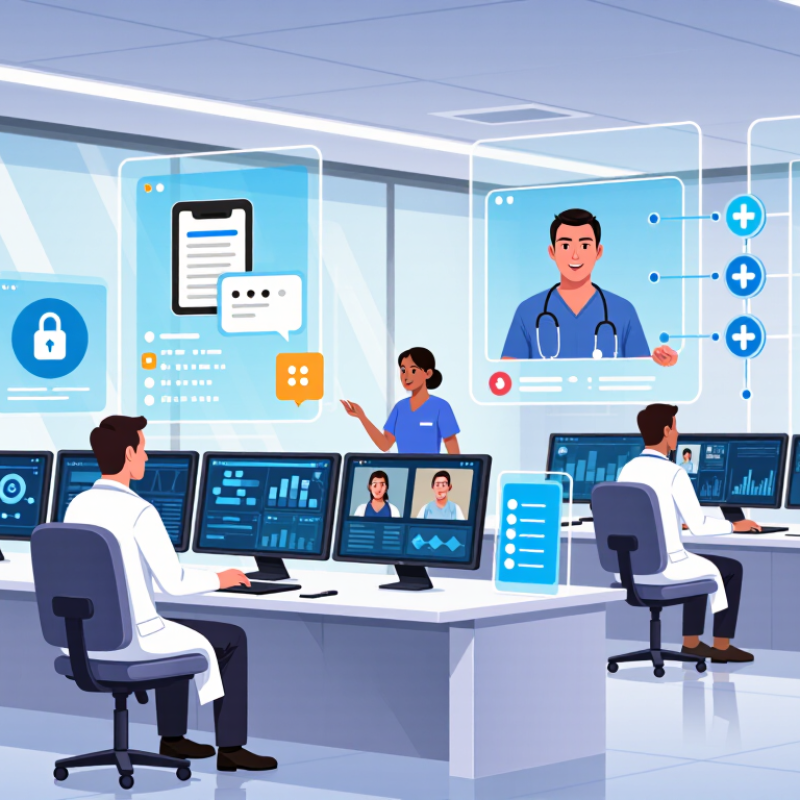
In 2026, digital healthcare transformation solutions are not simply apps, video visits, or new software. They connect clinical workflows, patient information, and decision-making across care settings. The World Health Organization’s Global Strategy on Digital Health 2020–2025 emphasizes people-centered, integrated digital health systems. In practical terms, that might mean a clinician seeing a patient’s medication list and recent test results before an appointment, rather than searching across disconnected screens. The technology matters. So does the workflow around it.
Evidence points to lasting demand for accessible digital care. McKinsey’s 2021 report, “Telehealth: A quarter-trillion-dollar post-COVID-19 reality?”, estimated that telehealth use had stabilized at levels 38 times higher than before the pandemic. That figure describes a changed care environment, not proof that every virtual service improves outcomes. A useful transformation plan therefore measures more than logins or video visits. It tracks timely follow-up, duplicated tests, staff workload, and whether patients can actually use the tools.
Interoperability, privacy safeguards, staff training, and clear clinical ownership are core parts of the solution. A rural clinic, for example, may need reliable remote monitoring and a simple way to flag concerning readings—not another dashboard that nobody checks. Yet integration remains messy, even in well-funded systems. That is worth admitting. Transformation is an ongoing redesign of care, and some digital processes will need to be reconsidered when they add friction instead of removing it.
A practical transformation strategy connects patients with secure, useful digital health information. These U.S. figures show the gap between being offered online access and actually using it.
In 2022, 73% of U.S. individuals were offered online access to their medical records, while 57% accessed them. The figures are an observed baseline, not a 2026 forecast. Source: Office of the National Coordinator for Health Information Technology (ONC), Health IT Data.
Healthcare transformation depends on reliable data, connected systems, and tools that fit clinical work. Interoperable electronic records help clinicians see medication lists, test results, and care plans in one place. The World Health Organization’s 2020 Global Strategy on Digital Health reported that 120 member states had a national digital health policy or strategy in 2019. That matters. A policy alone, however, cannot fix incompatible systems or rushed workflows.
Cloud infrastructure can support secure data exchange and scale computing, while artificial intelligence can help flag patterns in images and records. The U.S. Food and Drug Administration’s 2024 public inventory included more than 700 AI-enabled medical devices, with radiology the largest specialty. Remote monitoring adds another practical layer: a blood-pressure reading at home can inform a care team without another clinic visit. These tools need sound validation, clear oversight, and protection for sensitive health data. Still, technology can create extra alerts and widen gaps for patients with limited connectivity. That is not a small flaw. Teams should measure whether tools improve care in real settings, then revise what does not work.
A strong evaluation starts with a real clinical workflow, not a polished product demonstration. Follow one task, such as scheduling a follow-up, from the patient’s phone to the clinician’s screen. Count extra clicks, duplicate entries, and moments when staff must leave their usual workflow. Small interruptions add up.
Ask how the solution exchanges data with existing records, and test the exchange using realistic cases. Check whether information arrives accurately, on time, and in a format staff can understand. A clean demo is not enough. Include clinicians, administrators, IT staff, and patients in a limited pilot. Set measures before testing, such as documentation time, missed appointments, or support requests. Protect patient information through clear access controls, audit logs, and a documented response plan for system outages. Request evidence for performance claims, including how results were measured and which users were studied. Then check whether those findings apply to your setting. I would not assume every useful feature improves care; some create another screen to manage. Review accessibility, training needs, ongoing costs, and how easily the organization can export its data before committing.
2026 Best Digital Healthcare Transformation Solutions?
Leading Categories of Healthcare Transformation Solutions
Healthcare transformation is rarely one purchase; it is a set of connected capabilities shaped around clinical work. Strong programs begin with specific friction, such as duplicate data entry or delayed follow-up.
Electronic health record and interoperability solutions help teams share patient information across departments and care settings. Look for usable records, clear data permissions, and dependable exchange—not just a long feature list. Telehealth platforms extend consultations beyond clinic walls, while remote patient monitoring can surface changes between visits. A blood-pressure reading from home matters only when a care team can review it and decide what happens next. Small details count.
Analytics and decision-support tools can turn clinical and operational data into useful signals, such as rising appointment delays or missed screenings. Automation may reduce repetitive tasks, including routing forms and sending reminders. Cybersecurity and identity management belong in the same transformation plan, because connected systems need careful access controls and staff training. These categories overlap. That is normal. A rollout can still create extra clicks or uneven adoption, especially when workflows are designed without frontline input. Pilot changes with clinicians and administrative staff, measure practical outcomes, and revise what does not work. Technology helps, but it cannot repair unclear ownership or poor processes by itself.
A practical overview of major solution categories, common capabilities, interoperability considerations, and measurable evaluation criteria. Categories are not ranked; suitability depends on clinical needs, workflows, and local requirements.
| Solution Category | Core Capabilities | Typical Healthcare Use Cases | Data and Interoperability Considerations | Useful Evaluation Measures |
|---|---|---|---|---|
| Electronic Health Records and Clinical Information Systems | Clinical documentation, medication and allergy records, orders, results, scheduling, and longitudinal patient records. | Coordinating information across outpatient, inpatient, and specialty-care workflows. | Assess support for applicable HL7 messaging and FHIR-based exchange, terminology mapping, data migration, and role-based access. | Documentation time, record completeness, duplicate data entry, clinician usability, and successful exchange of clinical information. |
| Telehealth and Virtual Care | Video visits, remote consultations, digital intake, follow-up, and patient-provider messaging. | Remote follow-up, selected consultations, behavioral health visits, and access to care for patients who cannot easily travel. | Consider integration with clinical records, identity verification, accessibility, privacy safeguards, and applicable consent requirements. | Visit completion rate, appointment availability, patient experience, technical failure rate, and follow-up completion. |
| Remote Patient Monitoring | Collection and review of patient measurements from connected monitoring devices, with configurable alerts and care-team workflows. | Monitoring selected patients with chronic conditions or supporting care after discharge, when clinically appropriate. | Check device-data quality, units of measurement, patient matching, alert routing, and integration with the clinical record. | Measurement adherence, alert response time, actionable-alert proportion, escalation completion, and patient engagement. |
| Clinical Decision Support and AI-Enabled Tools | Contextual reminders, risk flags, clinical workflow assistance, and, where validated, analysis of structured or unstructured data. | Supporting clinicians with tasks such as care-gap identification, triage, and review of relevant patient information. | Require clinical validation, transparent intended use, data provenance, human oversight, bias monitoring, and change control. | Clinical validity, alert acceptance and override rates, subgroup performance, workflow impact, and safety-event monitoring. |
| Health Information Exchange and Interoperability | Secure sharing and retrieval of patient information among authorized healthcare organizations and systems. | Care transitions, referrals, emergency care, and reducing gaps caused by fragmented records. | Relevant standards may include HL7 FHIR and HL7 version 2 messaging; clinical concepts may use SNOMED CT, LOINC, and ICD-10, depending on purpose and jurisdiction. | Data match rate, exchange success rate, information availability at the point of care, and reduction in repeated tests attributable to missing records. |
| Medical Imaging and Diagnostic Data Management | Imaging storage, viewing, distribution, reporting workflows, and access to diagnostic results. | Sharing and reviewing radiology and other diagnostic images across care settings. | DICOM is a widely used standard for medical imaging; evaluate image access, metadata consistency, retention, and links to clinical records. | Image availability, report turnaround time, retrieval reliability, workflow delays, and completeness of imaging records. |
| Patient Engagement and Digital Access | Patient portals, appointment requests, reminders, access to selected records, digital forms, and secure communication. | Helping patients manage appointments, review information, and communicate with care teams through digital channels. | Consider accessibility, language support, identity and account recovery, privacy, and synchronization with scheduling and clinical systems. | Enrollment and active use, task completion, missed-appointment rate, accessibility feedback, and patient-reported experience. |
| Healthcare Cybersecurity and Identity Management | Access control, authentication, security monitoring, backup and recovery, vulnerability management, and incident response. | Protecting patient information and maintaining the availability of clinical and operational systems. | Assess encryption, least-privilege access, audit logging, secure integrations, recovery plans, and alignment with applicable privacy and security regulations. | Time to detect and respond to incidents, access-review completion, recovery-test results, and remediation of identified vulnerabilities. |
| Healthcare Analytics and Data Platforms | Data integration, dashboards, operational reporting, population-level analysis, and governed data access. | Monitoring service performance, care processes, resource use, and defined quality or population-health measures. | Document data definitions, refresh frequency, lineage, completeness, and appropriate de-identification or access controls. | Data quality, reporting timeliness, measure reproducibility, dashboard adoption, and completion of actions prompted by analysis. |
A credible digital health strategy begins with a specific care problem, not a shopping list of software. Map how patients and staff move through one process, such as appointment scheduling or medication follow-up. Note delays, duplicate data entry, missed messages, and the people affected. Then set a baseline before changing anything: average wait time, task completion rate, staff workload, and patient feedback. Small pilots help. Choose a clinic or service with clear boundaries, and include clinicians, operations staff, IT, and patients in planning. Their priorities may conflict, which is worth surfacing early.
Measurement should connect technical performance to care and daily work. Track whether a new digital pathway is usable, accessible, and reliable, alongside outcomes such as follow-up completion and time spent on administrative tasks. Define who reviews each measure and how often. Protect patient information through appropriate access controls, staff training, and routine security checks. Avoid treating logins or app downloads as proof of better care. They show activity, not value. A dashboard can also hide problems when averages obscure differences between patient groups. Review results by relevant demographic and access factors, while respecting privacy. Adjust the plan when the evidence disagrees with expectations; sometimes the workflow, not the technology, needs to change.