
Remain active
Inspired by patients, this revolutionary vest device allows airway clearance therapy during daily activities. A rechargeable battery powers therapy on the move.



It can be hard for people to fit therapy into their lives—even though they realize how important it is. That’s why we developed the Monarch Airway Clearance System. By allowing patients to move freely, it opens new possibilities for people to complete their therapy, their way.
The Monarch System uses revolutionary technology to provide High Frequency Chest Wall Oscillation (HFCWO) therapy while maintaining patient mobility. Targeted kinetic energy and airflow work together to thin and mobilize airway secretions—helping patients and their healthcare professionals breathe easy.

Inspired by patients, this revolutionary vest device allows airway clearance therapy during daily activities. A rechargeable battery powers therapy on the move.

A clinical study shows that the Monarch System aids in sputum production,1 helping give patients the freedom and flexibility to complete therapy while taking control of their lives.

The system is designed to travel easily—to the school, the airport, or anywhere patients need to go.
Take a quick tour of the Monarch System, a non-invasive airway clearance device for HFCWO therapy.
The Monarch System’s eight Pulmonary Oscillating Discs (PODs) are positioned to deliver targeted kinetic energy to the lungs. This targeted therapy generates airflow as patients go about their days—helping to thin mucus and mobilize secretions from the small to the large airways, where they can be coughed or suctioned out to help improve airway clearance.2-9
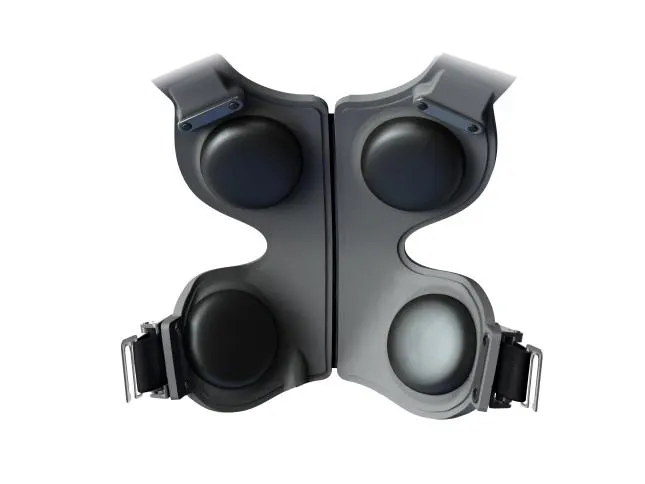
Front and back PODs operate in a pattern to optimize an oscillatory effect on the airways.
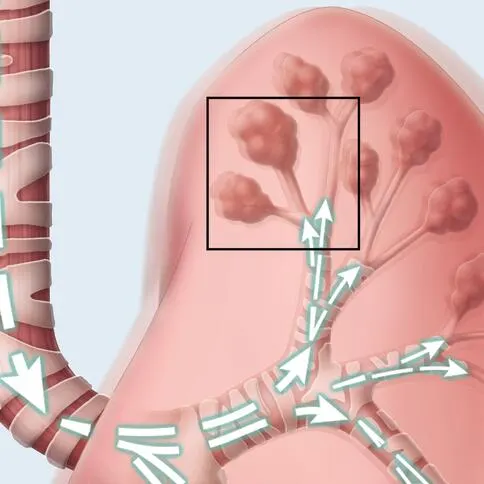
Oscillating PODs operate in a pattern that delivers targeted kinetic energy and generate airflow to loosen mucus in the lungs.
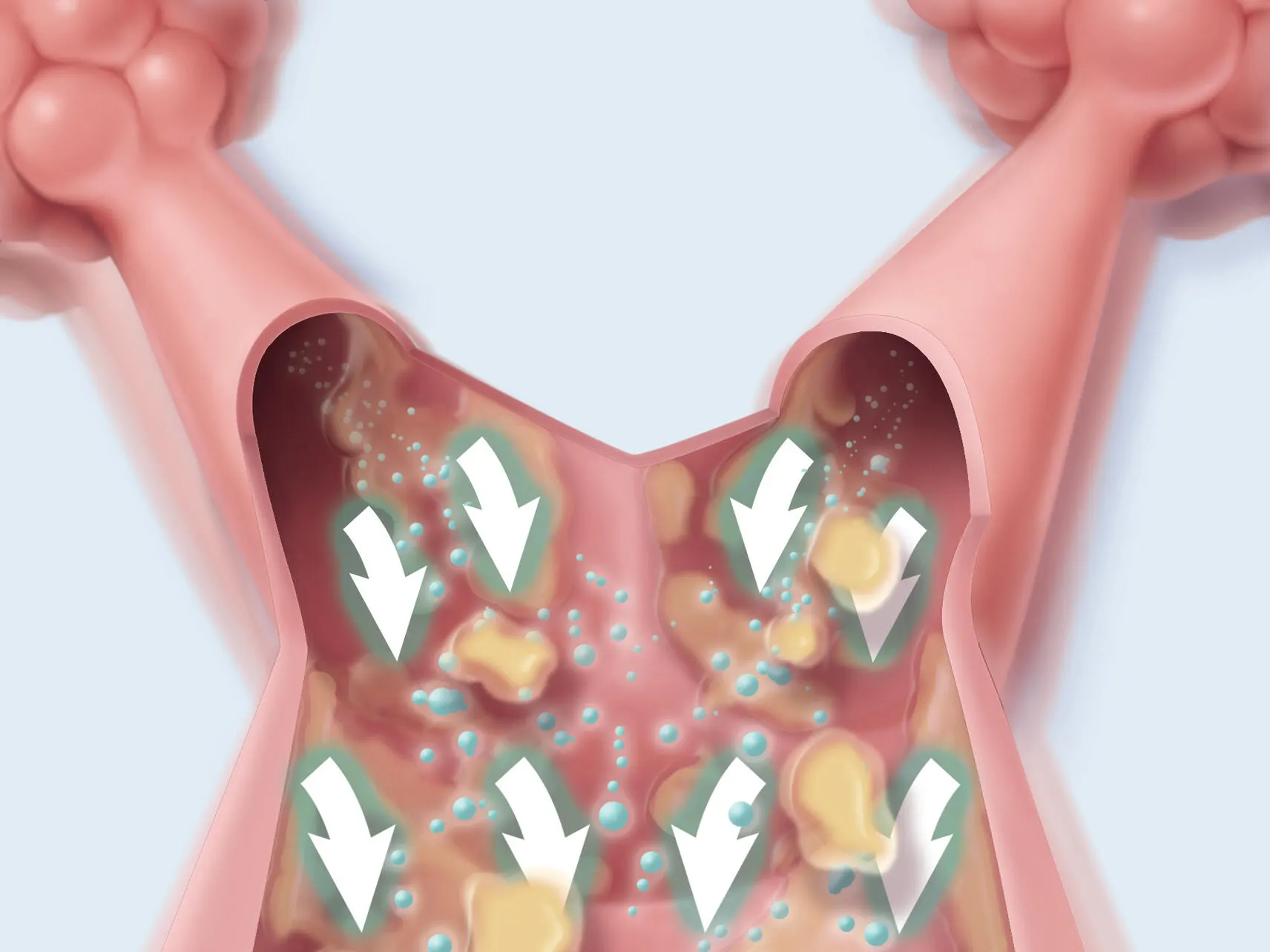
Air gets behind the mucus to help move it into the large airways, where it can be more easily expelled or removed.
When mucus builds up, it creates an environment in which bacteria can grow. This can lead to repeated, serious lung infections that can cause additional damage to the airways and a vicious cycle of infection. This cycle can lead to irreversible lung damage and respiratory failure. Many people with a chronic respiratory disease or condition have trouble clearing their lungs.
People with respiratory insufficiency have health conditions that affect how well their lungs help them breathe and exchange oxygen and carbon dioxide, including:
Cystic Fibrosis (CF): an inherited genetic condition where a faulty protein causes mucus to thicken and become sticky. When this mucus builds up, it can cause infections, blockage, or damage. Patients with cystic fibrosis may have difficulty clearing mucus from their airways which can lead to damaged, widened airways—otherwise known as bronchiectasis.3
Bronchiectasis: a condition where the lungs’ airways are abnormally stretched and scarred, resulting in mucus buildup. Bronchiectasis is often caused by an infection or other condition that injures the walls of the airways or prevents mucus from being cleared.

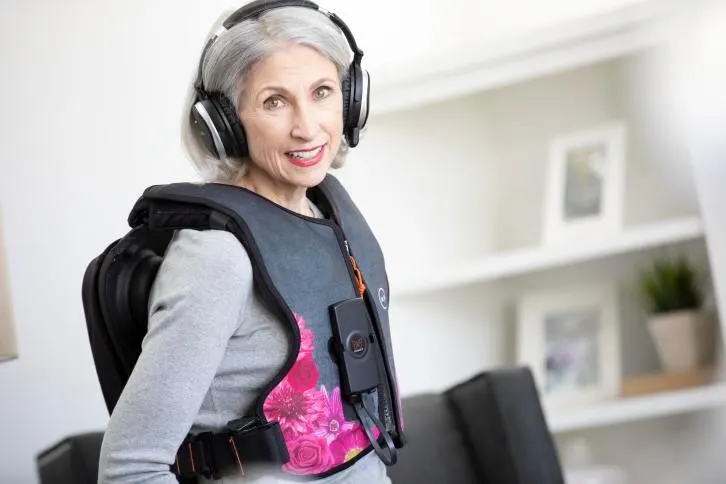
Sportswear-inspired design gives people freedom of mobility, and quiet operation allows normal conversation. A pendant control simplifies operation for the patient, and a rechargeable battery conveniently powers therapy as they go through their day.

Contains eight independently operating PODs that deliver targeted kinetic energy.

Intuitive and simple to use.

In patients’ choice of five colors; washable and dryable.

Retractable handle and backpack straps resemble ordinary luggage and make travel easy.

Powers therapy on the move.

The Monarch Airway Clearance System is cleared by the FDA to provide Airway Clearance Therapy and promote bronchial drainage where external manipulation of the thorax is the physician’s choice of treatment. It can help people living with diagnoses such as bronchiectasis and cystic fibrosis.
The Monarch Airway Clearance System is covered by Medicare and commercial insurance plans as High Frequency Chest Wall Oscillation (HFCWO) therapy. To find a provider, patients should call customer service at 1-800-426-4224 or email [email protected].
People who have respiratory insufficiency and have any of the following conditions should ask their doctor about the Monarch System:
Baxter created this program to deliver complete care at every step of the patient journey—helping improve the therapy experience for patients and offering new efficiencies for healthcare practices. We work with more than 1,000 leading local, regional and national companies, including commercial health plans and networks, Medicaid, Medicare, TRICARE and the Department of Veterans Affairs.
Our team of more than 200 professionals is ready to assist patients with:
For healthcare practices, it provides:
Marten Devlieger and his sister were both born with cystic fibrosis (CF). As they grew up, their mother had to manually perform chest physiotherapy (CPT) to help clear their airways.
But Marten envisioned a life with more independence. He created a mobile therapeutic device to provide him with the airway clearance therapy he needed. It freed him to travel, to pursue his love of kitesurfing, to have adventures, and to raise his own family.
And when Marten told us that he wanted others to experience the flexibility and control he’d claimed for himself, we gladly partnered with him to develop the Monarch Airway Clearance System.

Expiratory airflow bias is important, and kinetic energy transferred through the chest wall to the lungs is believed to help loosen secretions adhering to lung tissue.6-11 HFCWO creates kinetic energy designed to increase airflow to help mobilize secretions from the airways.4,6-7,9,11
*Comparisons are not based on head-to-head clinical efficacy studies. The clinical significance of these differences has not been established. Airflow test subjects were adult males with healthy lung function. Results for female subjects and patients with lung disease may vary from those in this study.

Kinetic Energy Delivered to the Chest Wall
This generates airflow to mobilize secretions and is believed to help loosen secretions.2,5 Impulse force was used to evaluate the kinetic energy delivered by an airway clearance system. Measuring this force applied over an acute period of time provides insight to the energy transfer through a chest wall to lung tissue.

Airflow to Mobilize Secretions
Pulse airflow was used to evaluate the airflow created by different airway clearance systems. Each pulse of airflow at the mouth was measured via software customized to measure oscillating airflow. Testing shows the Monarch System can generate up to 5x the airflow of the AffloVest System.2 **
** Systems tested were The Vest System Model 105, the Monarch System Model 1000, and the AffloVest Systems labeled as REF 8200 and 8300.

Data from a clinical evaluation of the Monarch Airway Clearance System by Leemans G., et al., were presented at the 2018 North American Cystic Fibrosis Conference (NACFC).
The researchers reported the Monarch System was comparable to The Vest System for sputum production.

Post-therapy evaluations of the Monarch System showed statistically significant improvement in Brody scores and FRI results, suggesting the device's relative airway clearance effectiveness.1
| Paremeter | Pre-MONARCH System Therapy Measurements | Post-MONARCH System Therapy Measurement | P-value |
| Brody Scores | 57.71 ± 16.55 | 55.2 ± 16.98 | p=0.001 |
| FRI (iVaw) | 49.442 ± 50.117 | 44.516 ± 49.637 | p=0.001 |
Download the clinical research summary to learn more.
To learn more, talk to your healthcare provider about the MONARCH System.
For more information, contact your Baxter sales representative or call 1-800-426-4224.


This video will show you how to place the new shoulder lift pads on your MONARCH Airway Clearance System garment, and how to evaluate and adjust garment fit settings, if needed.
The MONARCH Airway Clearance System training video will help educate patients, caregivers, and clinicians on how to use this device properly.
Rx Only. For safe and proper use of product mentioned herein, please refer to the Instructions for Use or Operator’s Manual.
Leemans G, Belmans D, Van Holsbeke C, et al. The effectiveness of a mobile high-frequency chest wall oscillation (HFCWO) device for airway clearance. Pediatr Pulmonol. 2020;55:1984–92.
Data on File at Baxter International Inc.
NIDCD Fact Sheet: Hearing and Balance. Noise-Induced Hearing Loss. National Institute on Deafness and Other Communication Disorders. NIH Pub. No. 99-4233. March 2014. Accessed March 7, 2024. https://www.nidcd.nih.gov/health/noise-induced-hearing-loss
Bench testing conducted in 2017. Testing was performed at the following therapy settings: The Vest System Model 105 and the Monarch System Model 1000 with intensity/pressure set at 10, frequencies settings at 5, 14, and 20 Hz; the AffloVest System was tested at the “Vibration” setting at “Low”, Medium” and “High” settings, which according to the AffloVest System web site operate at 5Hz, 13Hz, and 20Hz respectively. The AffloVest Systems used were labeled as REF 8200 and 8300. Testing consisted of measuring impulse force, or applied force over a timeframe of 30 seconds, via 4 force sensors placed on a mannequin in upper and lower chest locations. Comparisons are not based on head to head clinical efficacy or safety studies.
Independent lab testing conducted in 2017. Data was analyzed and compared average pulse airflows at the mouth generated by high frequency chest wall oscillation (HFCWO) therapy in 10 human subjects using home care garments. Airflows were measured via pneumotachometer at settings of the following: The Vest System Model 105 and the Monarch System Model 1000 with intensity/pressure set at 10, frequencies settings at 5, 10, 15, and 20 Hz; the AffloVest System was tested at the “Vibration” setting at “Low”, Medium” and “High” settings, which according to the AffloVest System web site operate at 5Hz, 13Hz, and 20Hz respectively. The AffloVest Systems used were labeled as REF 8200 and 8300. Comparisons are not based on head to head clinical efficacy or safety studies. Airflow test subjects were adult males with healthy lung function. Results for female subjects and patients with lung disease may vary from those in this study.
King M, Phillips D, Gross D, Vartian V, Chang HK, Zidulka A. Enhanced tracheal mucus clearance with high frequency chest wall compression. Am Rev Respir Dis. 1983; 128:511-5.
Dosman CF and Jones RL. High-frequency chest compression: a summary of the literature. Can Respir J. 2005. 12(1): p. 37-41.
Freitag L, et al. Removal of excessive bronchial secretions by asymmetric high-frequency oscillations. J Appl Physiol. 1989; 67: 614-9.
McCarren B, Alison JA. Physiological effects of vibration in subjects with cystic fibrosis. Eur Resp J. 2006; 27: 1204-9.
Murray M, et al. Critical Care Medicine Perioperative Management Second Edition by Lippincott Williams & Wilkins. 2002: p. 435.
Chest physical therapy. www.healthofchildren.com/C/Chest-Physical-Therapy.html. Accessed March 19, 2024.