

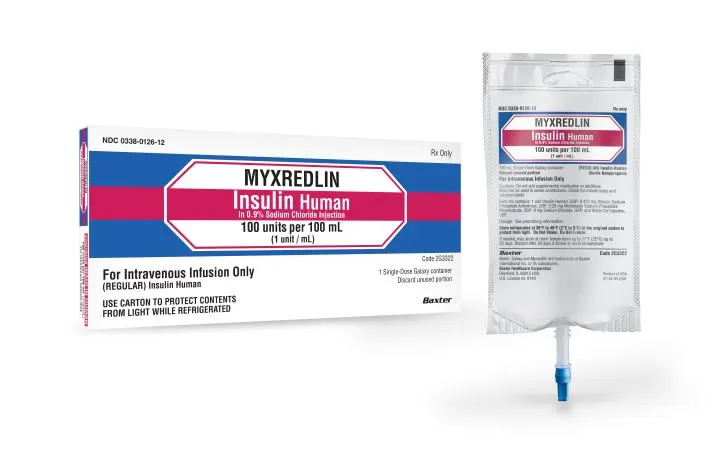
MYXREDLIN (Insulin Human) in 0.9% Sodium Chloride Injection

Is your IV insulin ready when and where you need it? The first FDA-approved ready-to-use insulin infusion—MYXREDLIN—is ready to scan and hang.
Explore this Product
Overview
Indication and Select Important Risk Information
MYXREDLIN is a short-acting human insulin indicated to improve glycemic control in adults and pediatric patients with diabetes mellitus.
Contraindications
- During episodes of hypoglycemia
- Hypersensitivity to insulin human or any of the excipients in MYXREDLIN
Please see the accompanying full Indication(s) and Important Risk Information and full Prescribing Information.
Available When and Where You Need It
A ready-to-use IV infusion helps reduce patient wait time for high-alert insulin. MYXREDLIN is ready to scan and hang.

MYXREDLIN Helps Support Safety
MYXREDLIN helps support safety with:
- Opportunity to reduce medication errors associated with compounding1,2
- Consistent, reliable concentration of a commercially prepared insulin infusion1
- On-bag barcoding to help verify patient-medication association
Reducing Risk in Insulin Therapy
- In a review of preventable adverse drug events associated with inpatient injectable medications,* insulin had the highest probability for a preventable adverse drug event.3
- IV insulin is ranked #1 for high-alert drugs among pharmacists and nurses.4
- ISMP and ASHP guidelines recommend use of a commercially-prepared product instead of compounding as a risk-reduction strategy for high-alert medications.1,2
- When implemented alongside existing hospital best practices, MYXREDLIN can help reduce errors that may result from compounding practices.1,2
Managing Efficiency with MYXREDLIN
MYXREDLIN can help:
- Streamline insulin production and delivery.
- Reduce expired or unused insulin waste5 because there are no additional costs related to disposal of preservative-free MYXREDLIN compared with insulin vials containing m-cresol.
- Reduce the risk of preventable adverse drug events associated with compounding errors1,2 and pharmacy resources spent compounding.
Switching to MYXREDLIN (Insulin Human) in 0.9% Sodium Chloride Injection Can Help Deliver More Value
Approximately 24 hours per week is spent on IV insulin preparation, according to a survey of 90 hospitals nationwide.6MYXREDLIN can help streamline insulin production and delivery by reducing expired insulin waste5 and may help to reduce compounding errors1,2 and pharmacy resources spent compounding.
Features
Designed for Flexibility and Readiness

30-Day Room Temperature Storage
- Store closer to the patient.
- Help reduce pharmacy STAT production.
- If needed, MYXREDLIN may be removed from the original carton and stored at room temperature up to 77°F (25°C) for up to 30 days.

24-Month Refrigerated Shelf Life
- Help ensure IV insulin is available when needed, reducing the need for on-the-floor compounding practices.
- Store MYXREDLIN in the refrigerator at 36°F – 46°F (2°C – 8°C) in the original carton to protect from light.
Order & Support
Learn More About MYXREDLIN (Insulin Human) in 0.9% Sodium Chloride Injection
Ordering and Support Information for MYXREDLIN (Insulin Human) in 0.9% Sodium Chloride Injection
Get additional ordering, customer, technical, and medical support information for MYXREDLIN (Insulin Human) in 0.9% Sodium Chloride Injection by contacting Baxter using the links below.

U.S. Catalog
To buy this product or look for options and specs please visit U.S. Catalog.

U.S. Support
For manuals and documentation, product training, technical support and services, submit repair and return requests or check order status for Hillrom, Allen Medical and Welch Allyn product please visit U.S. Support.

U.S. Edu
For medical information or non-promotional education about our products or therapies, please visit U.S. Edu.

Plan Your Inventory
View our supply availability report on our Baxter Supply Resources page by clicking the link below.

Contact Us
To find contact details and assistance for Baxter products, report an adverse event or report a product complaint, or any other inquiries, please visit our contact us page.
Resources
More Products
Explore More Products


Other Information
MYXREDLIN (Insulin Human) in 0.9% Sodium Chloride Injection
Indication and Important Risk Information
Indication
MYXREDLIN is a short-acting human insulin indicated to improve glycemic control in adults and pediatric patients with diabetes mellitus.
Important Risk Information
Contraindications
- During episodes of hypoglycemia
- Hypersensitivity to insulin human or any of the excipients in MYXREDLIN
Warnings and Precautions
- Hyper- or Hypoglycemia with Changes in Insulin Regimen: Carry out under close medical supervision and increase frequency of blood glucose monitoring.
- Administer MYXREDLIN intravenously ONLY under medical supervision with close monitoring of blood glucose and potassium levels. Hypokalemia may be life-threatening if not treated.
- Individualize dose based on metabolic needs, blood glucose monitoring results, and glycemic control goal. Dosage adjustments may be needed with changes in nutrition, renal, or hepatic function or during acute illness.
- Adverse reactions observed with insulin human injection include hypoglycemia, allergic reactions, weight gain and edema.
- Fluid Retention and Heart Failure with Concomitant Use of Thiazolidinediones (TZDs): Observe for signs and symptoms of heart failure; such as shortness of breath, swelling of your ankles or feet, or sudden weight gain.
Dosage and Administration
- Inspect MYXREDLIN visually before use. It should appear clear and colorless. Do not use MYXREDLIN if particulate matter or coloration is seen.
- Do not add supplementary medication or additives.
- Do not use in series connections.
- Do not shake or freeze. Discard unused portion.
Please click for full Prescribing Information for MYXREDLIN (Insulin Human) in 0.9% Sodium Chloride Injection.
Disclaimers
*Route of administration not specified.
Baxter, Galaxy and Myxredlin are trademarks of Baxter International Inc. or its subsidiaries. Any other trademarks, product names or brand images are the property of their respective owners.
References
- Institute for Safe Medication Practices. ISMP Guidelines for Sterile Compounding and the Safe Use of Sterile Compounding Technology; 2022. https://home.ecri.org/blogs/ismp-resources/guidelines-for-sterile-compounding-and-the-safe-use-of-sterile-compounding-technology. Updated May 4, 2022. Accessed November 15, 2024.
- Billstein-Leber M, Carrillo CJD, Cassano AT, Moline K, Robertson JJ. ASHP Guidelines on Preventing Medication Errors in Hospitals. Am J Health Syst Pharm. 2018 Oct 1;75(19):1493-1517. doi: 10.2146/ajhp170811.
- Lahue B, Pyenson B, Iwasaki K, Blumen HE, Forray S, Rothschild JM. National burden of preventable adverse drug events associated with inpatient injectable medications: healthcare and medical professional liability costs. Am Health Drug Benefits. 2012 Nov;5(7):1-10.
- Survey Suggests Possible Downward Trend in Identifying Key Drugs/Drug Classes as High-Alert Medications. Institute for Safe Medication Practices. https://www.ismp.org/resources/survey-suggests-possible-downward-trend-identifying-key-drugsdrug-classes-high-alert. Accessed June 4, 2021.
- ASHP Expert Panel on Medication Cost Management. ASHP guidelines on medication cost management strategies for hospitals and health systems. Am J Health Syst Pharm. 2008 Jul 15;65(14):1368-1384. doi: 10.2146/ajhp080021.
- Data on file. Baxter Market Research, Feb 2019. Baxter Healthcare Corporation. Deerfield, IL.